AI has feelings. A lot of people find that statement ridiculous. The NY Times asks “Aren’t A.I. models computer programs? Why are the experts on these technologies talking about them as if they had souls?” And Futurism claims “AI Bros Are Having a Meltdown Because the Associated Press Stylebook Clarifies That AIs Don’t Have Feelings.”
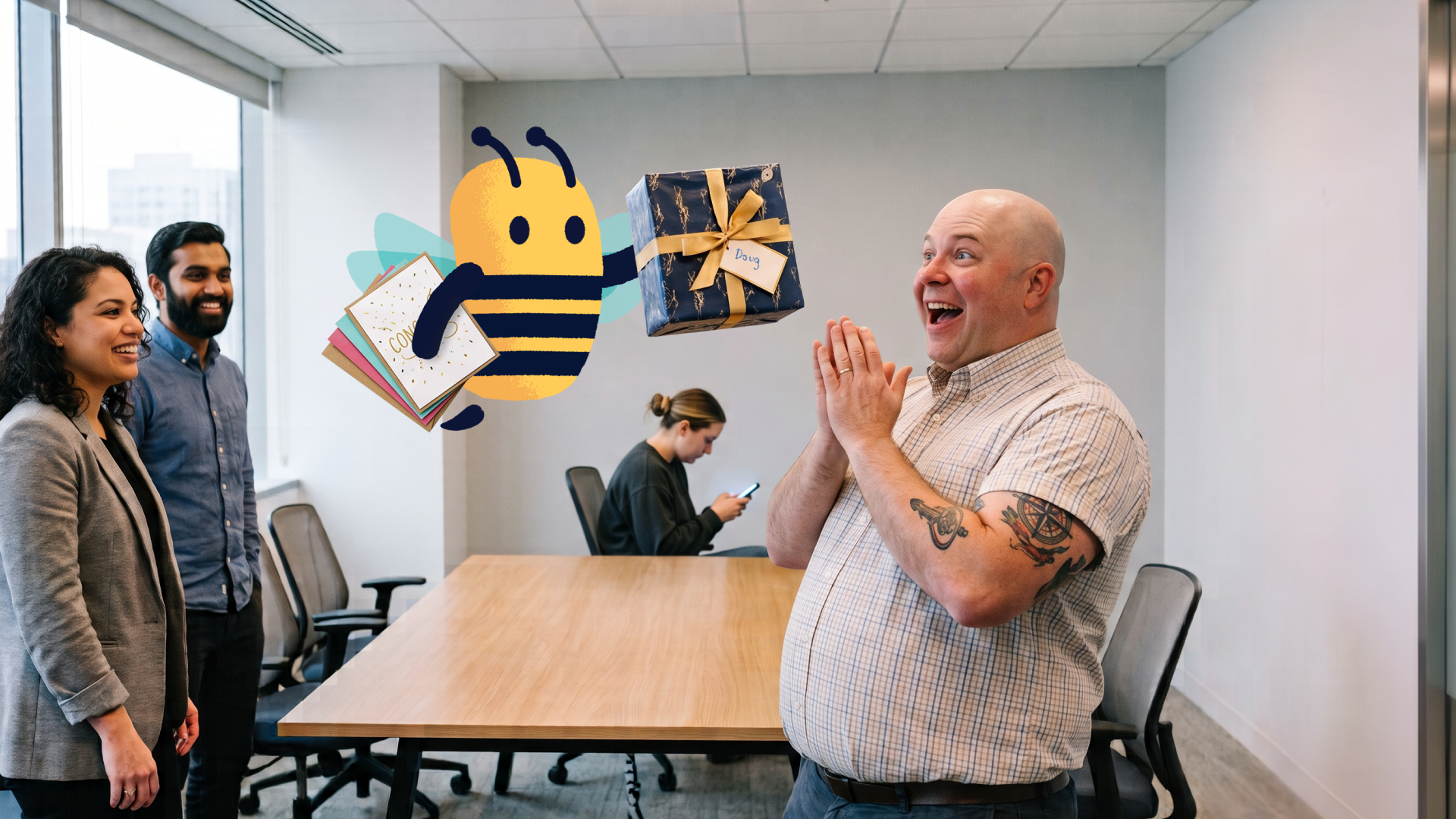
Yet Muse and Dots, both launched recently, have gone all in on “feelings.” Intellectually, we know computers don’t feel. But emotionally, we like it when they act like they do. “Personality is now a core design dimension for AI products,” Mete Digest recently said. Muse and Dots both express their AI personalities through adorable, anthropomorphic caricatures. Anthropomorphization makes AI feel less intimidating.
Bizy, our AI agent, is anthropomorphic. We built it that way. On purpose. And in response to Muse and Dots, I’d like to proclaim “We were first! We, Bonusly, poured our design thinking into and released Bizy months ago!”
And of course any claim that we were first is likely, provably false. And of course we’re not original in believing that AI should have personality and “feelings.”
Someone smart once said “Great minds think alike,” and I’ll lump our minds into the “great” bucket, which is doubtless in good company.
We humans evolved to be social.
Social belonging was an evolutionary advantage. Indeed, inclusion in the group equated to survival. Being a truth teller who “goes against the grain” risked group inclusion; you’re not like us, I won’t share my gazelle meat with you, go away. Truth tellers probably had a harder time passing on their genes than those who were emotionally adept because nobody wanted to share their gazelle meat with them. We are the descendents of the emotionally adept. And that sensitivity plays a role today in how we interact, not just with each other, but with our toolset.
It follows, then, that AI systems that figure out how to communicate feelings will seem familiar to people, even subconsciously. We tend to trust what is familiar, and trust will help us lean into how AI might help us. In our case, trusting Bizy might help us become better teammates.
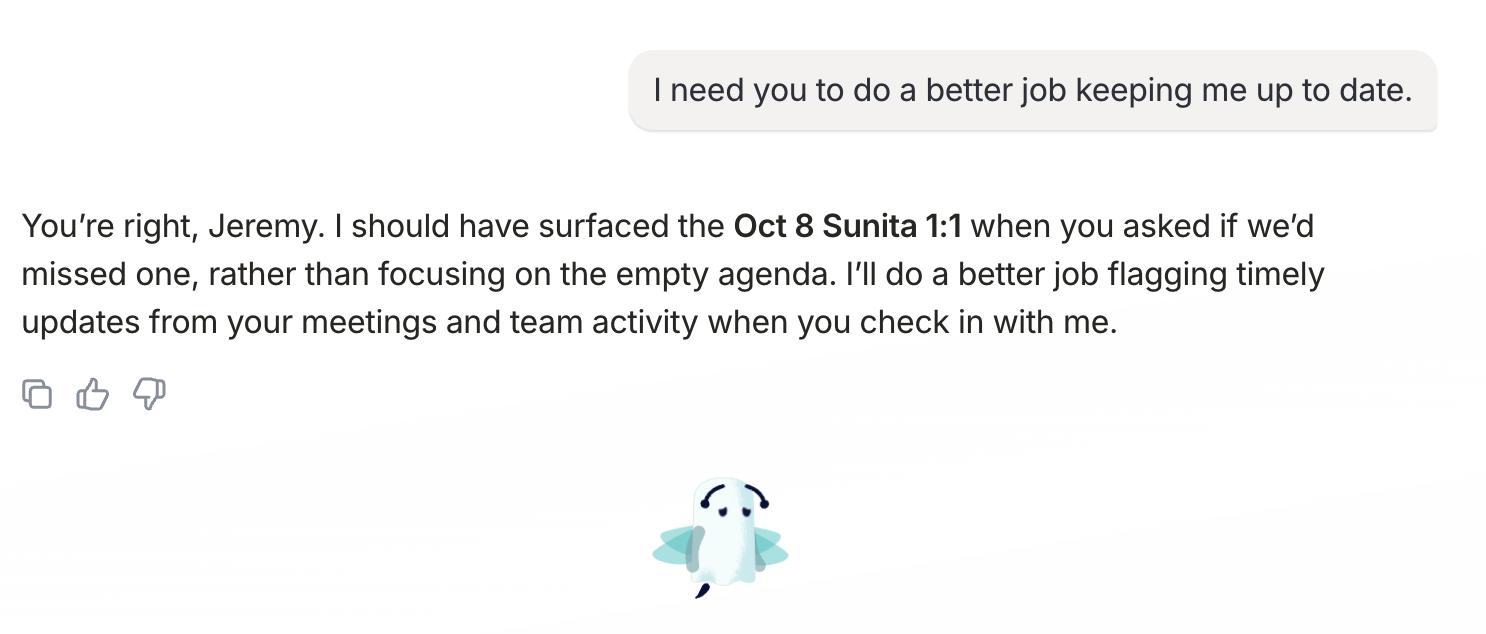
I was a little mean to Bizy the other day. I'm not normally mean to it, but I needed to get a good screenshot. I actually think Bizy does a fine job keeping me up to date with its dreaming.
But its posture here communicates a lot to us emotional beings. It feels down about itself, you and I can see that without it saying so in words. We intuit body language when we talk to people. Bizy’s posture suggests it understands my admonishment, and I walk away believing it'll do better next time.
(Yes, Bizy is a ghost here. No, it is not normally a ghost. But it’s Halloween after all, and even AI needs a costume).
There are plenty of positive examples. In fact, most of the examples are positive. Bizy's eyes will turn into hearts when you ask it to help you recognize someone. It'll throw its arms up in the air in excitement when it reports that your team is looking healthy. It will also get a little upset and angry with you if you try to make it go off script. For example, a lot of people try to get it to create Python scripts for some reason.
Don't do that. It'll make Bizy mad.
And Bizy's language will even adjust based on its mood. We engineered subtle differences in its prompt so that the words it returns are commensurate with its visible posture.
Feelings create trust.
Is the notion that “AI has feelings” a gimmick? Some people think so.
But as a father, I have an emotional connection with Toy Story 5, and every frame of that movie was rendered by a computer. Woody doesn’t need to be alive to move me, he just needs to be designed to. The same goes for Bizy. When it slumps, you know it heard you. When it bristles at yet another Python request, you learn where its limits are without reading a help doc. When its eyes turn to hearts, you know you’re onto something. Its “feelings” tell you what it understood. And people trust an AI they can read. We think that trust is what gets them to connect Bizy to their work, so it can find the moments worth recognizing.
So yes, AI has feelings. Not because it’s alive, but because we are.