


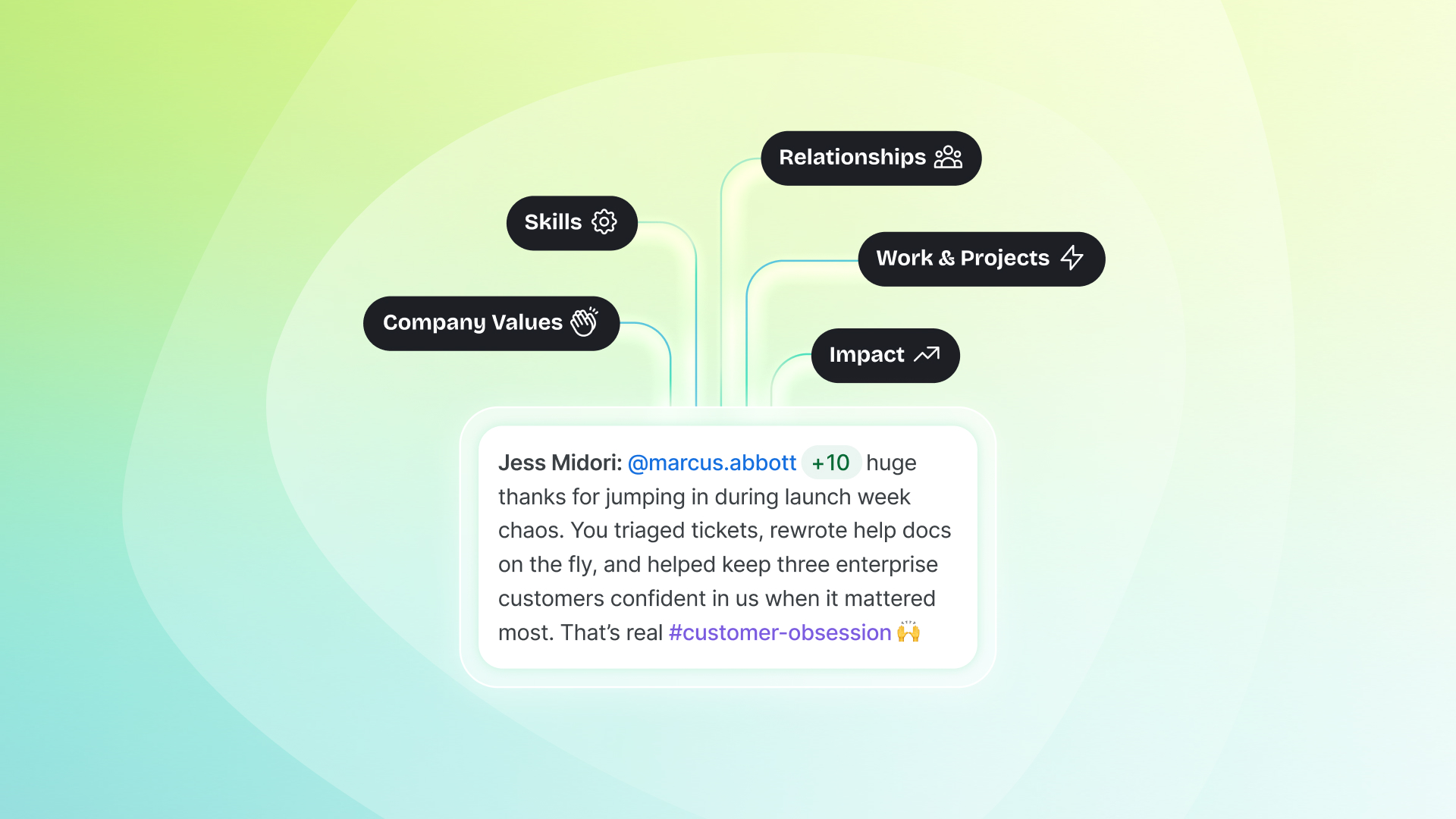
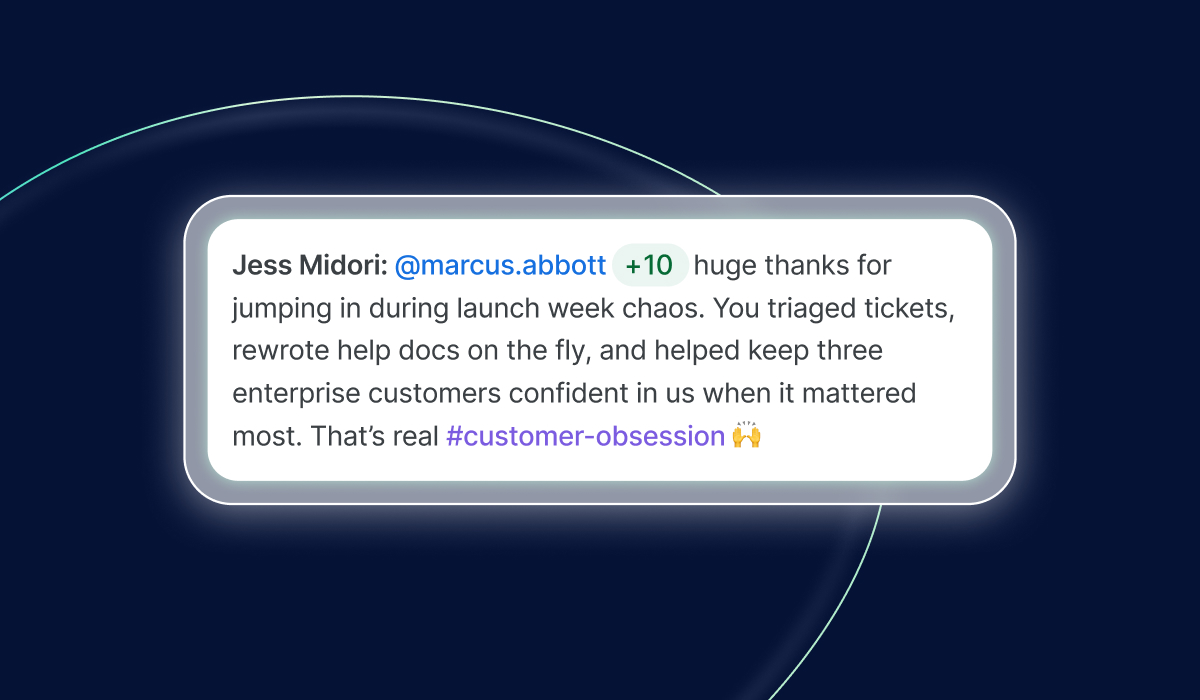
Picture a shoutout sent on a Tuesday afternoon in February. A customer success manager, Dana, wrote a few meaningful sentences thanking her coworker Marcus for jumping into a chaotic product launch week: triaging tickets, rewriting help documentation on the fly, and keeping three enterprise clients from churning. The message took Dana maybe two minutes to write. She tagged it with the company value #customer-obsession and sent it.
That recognition did something small and something large at the same time.
- The small thing: Marcus felt seen for work that maybe wouldn’t have shown up in an annual review.
- The large thing: Dana's recognition created a data point that, sitting alongside dozens of others like it, started to sketch the outlines of something HR leaders rarely get to see in real time: what their culture actually looks like on the ground.
Culture lives in the everyday work
Most organizations can tell you what their culture is supposed to be. They've defined their core values, printed them on the walls, displayed them on their company About page, and threaded them into the onboarding deck. Yet, what they struggle to tell you is whether those values are actually showing up in how people work on a Tuesday afternoon in February, during a chaotic product launch.
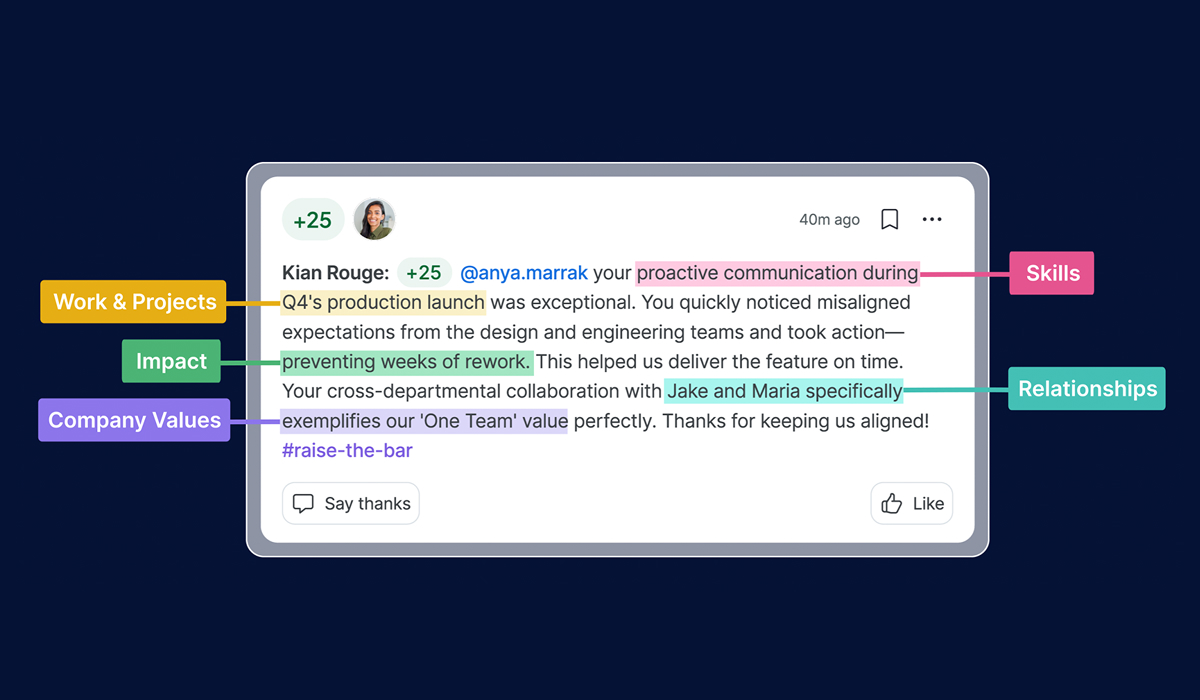
Recognition, when it's specific and peer-driven, closes that gap. When Dana writes that Marcus "rewrote three help articles on a Friday evening to prevent customer confusion and frustration," she's documenting a behavior, naming a skill, and signaling to everyone who reads it what "going above and beyond" concretely looks like at this company.
Do that at scale—across hundreds of employees, over months—and patterns emerge that no engagement survey can capture.
You start to see:
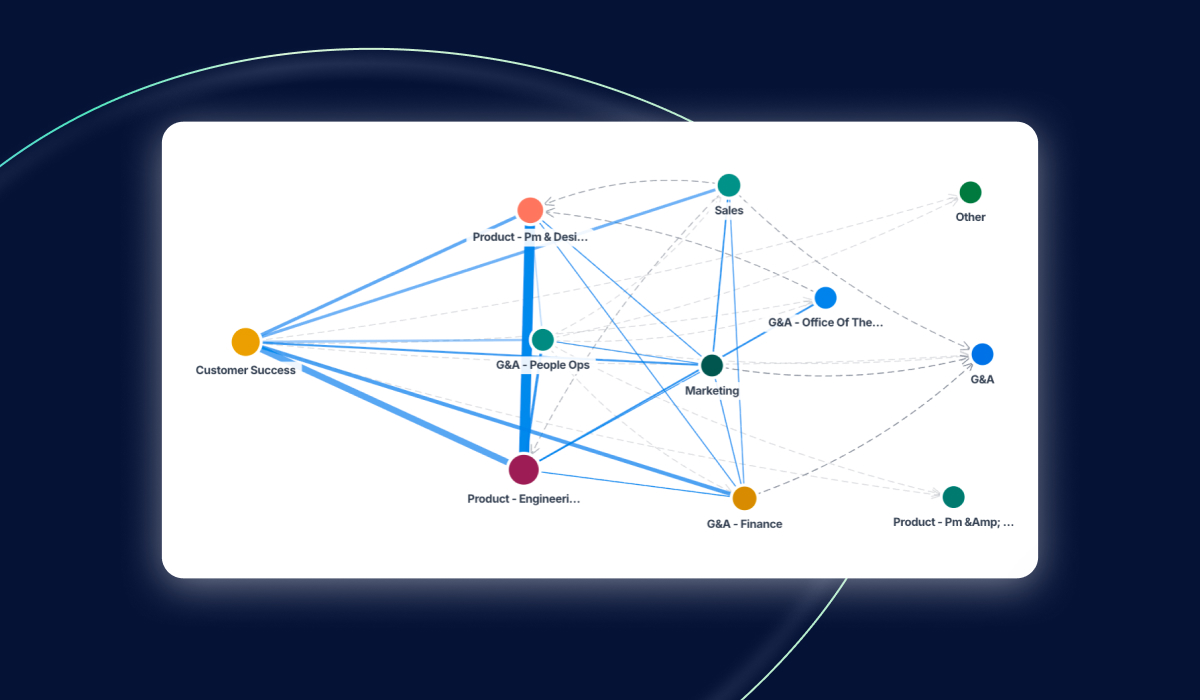
- which teams collaborate across functions, and which operate in silos
- which stated values get reinforced socially and which ones are aspirational at best
- who the connectors are, the people who show up in other people's recognition repeatedly, often long before they surface in a formal talent review.
Research supports this: organizations with strong recognition cultures see significantly higher employee engagement, and engaged teams show about 23% higher profitability, according to Gallup.
But aggregate numbers only tell part of the story. The proof is in the individual messages; the specifics that tell you not just that collaboration is happening, but how and with whom.
What HR leaders can actually do with recognition data
This is where recognition shifts from a feel-good program into a strategic, continuous performance tool.
When an HR leader can look at six months of recognition data and see that one value—say, #customer-obsession—is being tagged consistently by the customer success team but almost never by the product team, that's a conversation worth having with the VP of Product. It's not a performance problem yet; it might be a culture misalignment, or a gap in how that team understands the value, or simply a reflection of how differently their work connects to their customers.
Any of those is actionable, but none of them would have surfaced in a survey.
Recognition also has a way of surfacing emerging leaders before the org chart catches up with them. Consider a mid-level engineer who, over the course of a year, appears in the recognition feeds of five different teams for things like mentoring a junior developer, translating technical constraints into language the marketing team could use, and flagging a process inefficiency nobody else had named. Her manager knows she's good, but the recognition record shows she's a connector, a teacher, and a systems thinker.
That's a different conversation about her development than the one her manager would have walked into a performance review prepared to have.
Employee Appreciation Day as a forcing function
Employee Appreciation Day tends to get treated as a cheerful Friday where everyone posts something nice and participation numbers look great in the monthly report. That's not nothing, but it's not the bigger opportunity, either.
The real value of a day like this is that it creates a forcing function for quality. When people are primed to recognize colleagues, HR leaders can raise the bar on how they do it: encouraging specificity over vague praise, prompting people to connect the behavior they're describing to a company value, and asking managers to spotlight someone whose contributions tend to go unnoticed.
The difference between "Thanks for everything, Julia!" and "Julia rebuilt our onboarding checklist after three new hires told her the old one was confusing, and new hire 90-day retention has been measurably better since" is a data point in disguise.
Done this way, the day generates stories and examples that leaders can actually act on. A VP who reads through the recognition feed after a well-run Appreciation Day has material: real examples of culture in action, names of people doing quiet but significant work, and signals about where teams are thriving and where they might need support. That's real organizational knowledge that compounds.
The recognition ripple effect
One message names a contribution, but a hundred messages reveal how people actually work together. Consistent recognition, over time, defines what great looks like inside a specific company. Not "we value collaboration" but "here is what collaboration looked like when the product launched late and three enterprise clients were at risk."
That's the bigger story recognition tells. And for People leaders trying to shape cultures that are both built from the ground up and high-performing, that story is one of the most valuable things they have access to.


%2520(1).webp)


